📰 Technology That Saves Lives: Hyundai Motor Group Deploys Unmanned Firefighting Robots to Protect First Responders
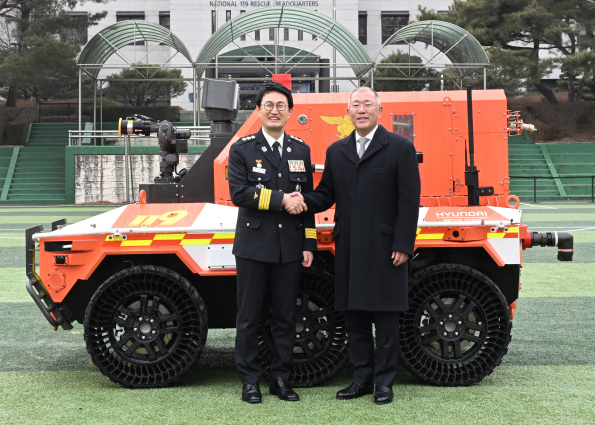
When environments become too dangerous for human lungs and limbs, technology must step into the gap. Zohari Cars is proud to cover a profound leap in disaster response as Hyundai Motor Group officially donates four state-of-the-art unmanned firefighting robots to the Korea National Fire Agency (KNFA). In a high-stakes donation ceremony held on February 24, 2026, Hyundai’s Executive Chair, Euisun Chung, emphasized that these robots are more than just machines—they are designed to be "reliable teammates" that enter extreme danger zones first, ensuring our human heroes can carry out their missions in a safer environment.
The HR-Sherpa Platform: Built for Extremes
At the core of these robotic firefighters is the HR-Sherpa platform—an electrified, multi-purpose unmanned vehicle developed by Hyundai Rotem. While the platform has its roots in military combat suitability, it has been heavily reinforced for the fire line. The robot’s body is built to withstand blistering external temperatures ranging from 500°C to 800°C. To maintain operational stability in such heat, it features a self-spraying "water curtain" system that creates a continuous film of coolant around the exterior, keeping the robot’s internal components at a safe 50-60°C even while it sits at the heart of an inferno.
Precision Suppression and Search
Equipped with a front-mounted water cannon, the robot can deliver both direct and spray-type water streams to address complex fire patterns remotely. To "see" through the thickest smoke and blinding flames, the unit utilizes an infrared sensor-based camera and an AI-based vision enhancement algorithm. This technology allows remote operators—connected via real-time wireless video—to identify a fire's origin or locate individuals in need of rescue without ever stepping into a hazardous area. With a six-wheel independent in-wheel motor system and high-temperature-resistant tires, these robots can effortlessly climb over debris and structural collapse that would stop conventional firefighting vehicles in their tracks.
For the Zohari Cars community, this is a powerful example of "technology that saves lives." Hyundai cites a sobering statistic: over 1,800 firefighters have been injured or killed in the line of duty over the past decade. By deploying these robots for initial suppression and search in large-scale blazes or structural collapses, Hyundai is actively reducing those risks. The Group plans to expand this fleet to 100 units in the coming years and will even support the new National Fire Hospital opening this June. Stay tuned as we track how this "paradigm shift" in disaster response continues to evolve with even more advanced AI and downsizing for confined space rescue.